RYA Day Skipper standard — precise, complete, practical
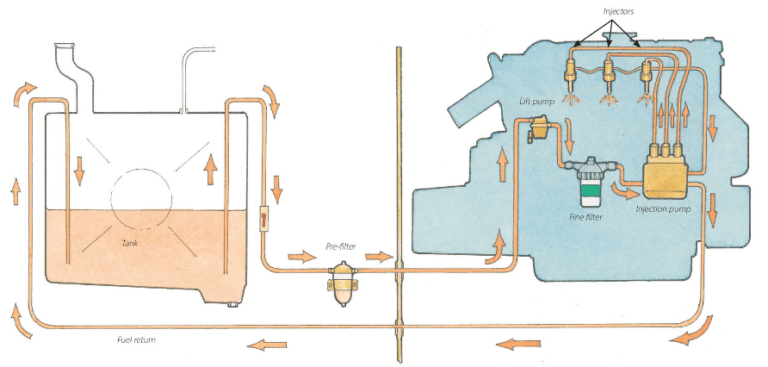
A marine diesel fuel system has one job: deliver clean, air-free fuel at the correct pressure and timing to the injectors, then return excess fuel to the tank. Most diesel engine stoppages are fuel contamination or air ingress.
1) System Overview
Two “pressure worlds”
Low-pressure supply side (tank → filters → lift pump → injection pump)
Purpose: deliver a steady flow of clean fuel.High-pressure injection side (injection pump → injector pipes → injectors)
Purpose: deliver fuel at very high pressure, precisely timed, finely atomised.
2) Components and Flow Path (in order)
2.1 Fuel tank
Stores diesel.
Has a fuel pick-up (often above the very bottom to avoid sludge).
Has a tank vent: if blocked, a vacuum forms and fuel flow reduces/stops.
Often has a fuel gauge (not always reliable—confirm by soundings if needed).
2.2 Shut-off valve (fuel cock)
Manual valve at tank outlet.
Used for emergencies (fire/leak), maintenance, filter changes.
2.3 Primary filter / water separator (pre-filter)
Removes water and larger particles before fuel reaches the engine.
Commonly has a clear bowl and drain to remove water.
Water here is a major cause of rough running/stoppage.
2.4 Fuel lift pump (low-pressure pump)
Draws fuel from tank through the primary filter.
May be:
Mechanical (cam-driven diaphragm type), often with a hand-priming lever, or
Electric pump (some installations).
Provides fuel to the secondary filter/injection pump at low pressure.
2.5 Secondary (fine) filter
Removes fine contaminants to protect injection equipment.
Common cause of power loss: clogged secondary filter.
After changing it, air must usually be bled.
2.6 Injection pump (high-pressure pump)
Pressurises fuel to very high pressure and meters it accurately.
Times injection to each cylinder (mechanical systems) or works with electronic control (modern engines).
Excess fuel is often used for cooling/lubricating the pump and then returned.
2.7 High-pressure pipes
Rigid steel lines from injection pump to injectors.
Must be clean, undamaged, correctly secured.
Never loosen while running (high-pressure hazard).
2.8 Injectors (nozzles)
Open at a set “pop” pressure.
Atomise fuel into the combustion chamber as a fine spray.
Correct atomisation is essential for efficient combustion and low smoke.
2.9 Leak-off / return line
Returns excess fuel from injectors (and sometimes from injection pump) back to the tank.
Keeps system cooler and purges small amounts of air.
3) What makes diesels stop (RYA emphasis)
3.1 Contamination (dirt / sludge)
Blocks filters → fuel starvation → loss of power → stoppage.
Often triggered when sea state stirs tank sediment.
3.2 Water in fuel
Causes misfiring, rough running, filter blocking, corrosion.
Removed via water separator drain.
3.3 Air in the system (most common “sudden stop”)
Diesel injection relies on solid columns of fuel.
Air bubbles compress → injection pump cannot build correct pressure → engine stops or won’t start.
Air gets in via:
Running tank low
Loose unions
Cracked hose
Poorly sealed filter after service
4) Bleeding / Priming (Day Skipper practical expectation)
When air is present (after filter change, fuel run-out, leak repair), you must remove it.
Typical bleeding sequence (varies by engine):
Confirm fuel shut-off valve open and there is fuel in tank.
Use hand primer (or electric pump) to push fuel through.
Open bleed screw on primary filter (if fitted) until fuel runs bubble-free → close.
Open bleed screw on secondary filter / injection pump feed until bubble-free → close.
Some systems self-bleed; others require final bleed at injection pump points.
Start engine; if it fires then dies, air is still present—repeat methodically.
RYA principle: bleed from low-pressure side upwards, and close each bleed point once bubble-free fuel appears.
5) Practical Symptoms and What They Usually Mean
Gradual loss of power / surging: filters blocking, tank vent blocked, fuel starvation.
Engine stops suddenly: air ingress, fuel shut-off closed, severe blockage.
Won’t start after service: air trapped, bleed not complete, filter seal not seated.
Black smoke + poor power (can be fuel/air mix): over-fuelling, restricted air intake, dirty prop; fuel system may be fine.
White smoke on start: unburnt fuel (cold, poor compression, injector issue) — not usually “filter” related.
6) Day Skipper Standard Safety Notes
Never use naked flames near fuel.
Clean spills immediately; ventilate.
High-pressure injection fuel can penetrate skin—never check injector leaks with fingers.
Carry spares: primary and secondary filters, seals, and correct tools.
Revision Summary (Speakable)
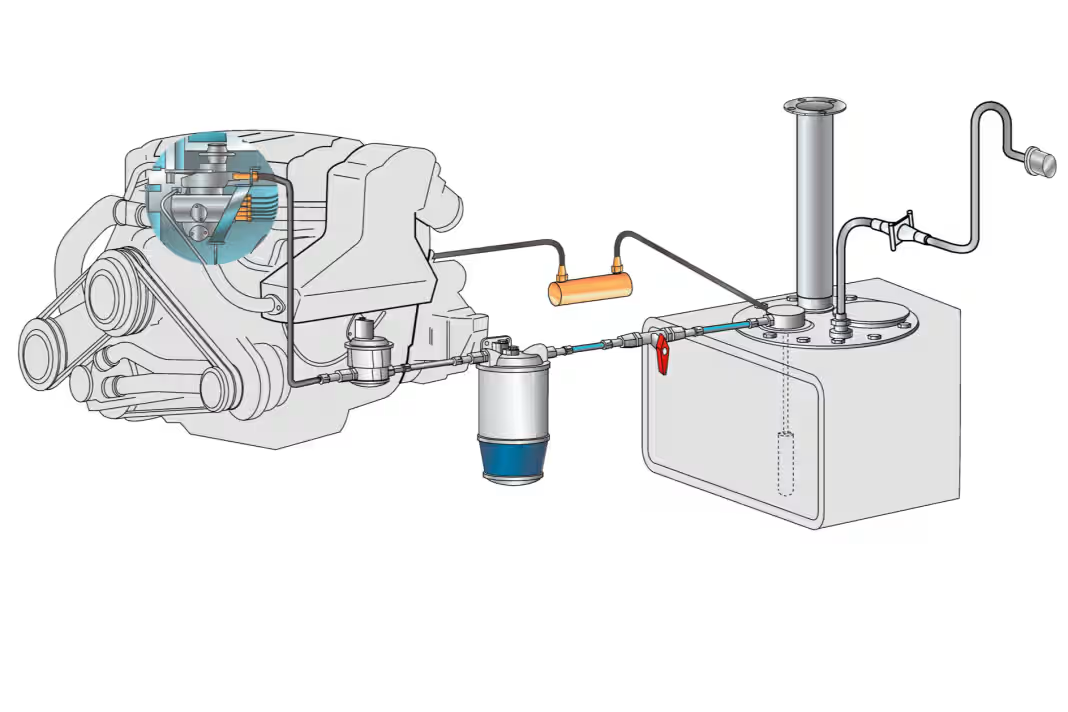
Tank → shut-off → primary filter/water separator → lift pump → secondary filter → injection pump → high-pressure pipes → injectors → return line to tank.
Failures are usually dirt, water, or air; after disturbance or servicing, bleed the system until fuel runs bubble-free.
“I use IWOBBLE for pre-start checks, then confirm water flow, oil pressure, and charging immediately after start.”