RYA Day Skipper standard — precise, complete
A marine diesel engine converts fuel energy into power and heat. The cooling system removes excess heat to keep the engine within its safe operating temperature. Loss of cooling is a stop-the-engine fault.
1) Cooling System Types (RYA classification)
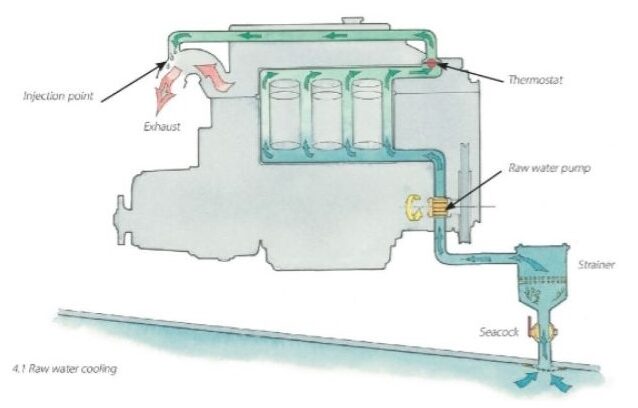
1.1 Raw Water Cooling (direct)
Seawater drawn from outside the boat.
Passes directly through engine water passages.
Discharged with exhaust.
Simple but corrosive; found on older/smaller engines.
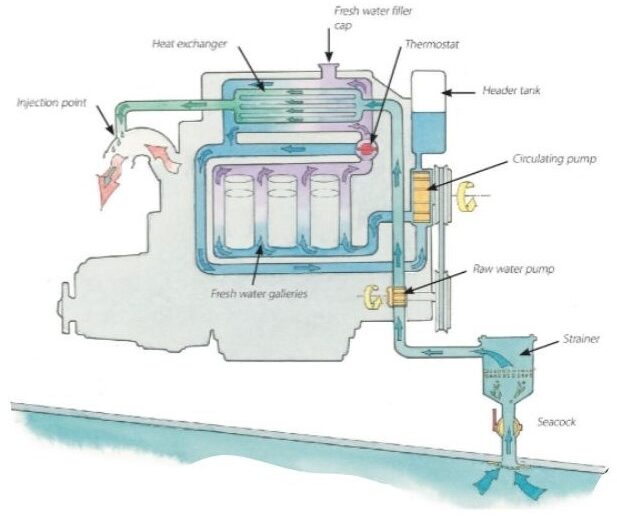
1.2 Indirect (Freshwater) Cooling (most common)
Engine cooled by a closed freshwater circuit (with antifreeze).
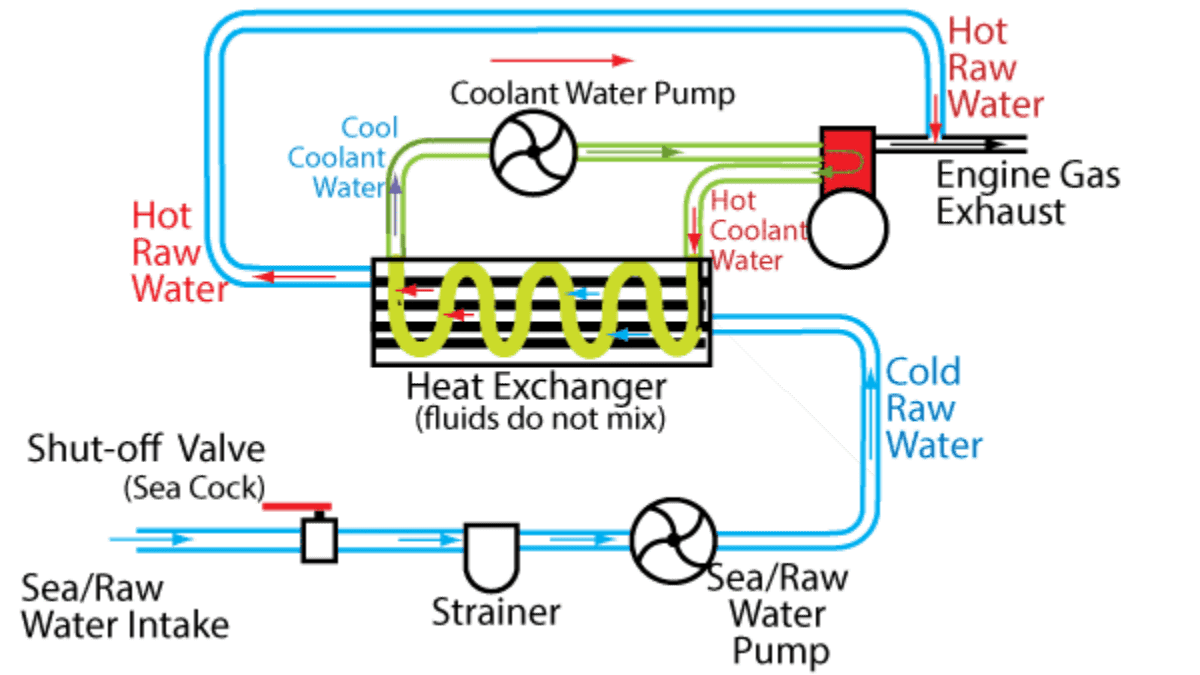
Seawater cools the freshwater via a heat exchanger.
Better temperature control and reduced corrosion.
2) Raw Water Side (Seawater Circuit)
Flow path (in order):
Seacock (raw water inlet)
Must be OPEN for engine operation.
Closed seacock = immediate overheating.
Strainer
Removes weed, debris, shells.
Blockage reduces or stops flow.
Raw water pump (impeller pump)
Flexible rubber impeller driven by engine.
Wear item; blades can fail or shear.
Heat exchanger (indirect systems)
Seawater passes through tubes, cooling freshwater circuit.
Mixing elbow (water injection point)
Seawater injected into exhaust gases to cool them.
Exhaust system
Water-cooled exhaust carries heat and gases overboard.
Visual confirmation: water discharge at exhaust outlet.
3) Freshwater Side (Indirect Cooling Only)
Flow path:
Freshwater pump (engine-driven)
Circulates coolant through engine.
Engine block and cylinder head
Coolant absorbs heat from combustion areas.
Thermostat
Controls engine temperature by regulating coolant flow.
Closed when cold (faster warm-up).
Opens at operating temperature to allow cooling.
Heat exchanger
Transfers heat from coolant to seawater.
Header/expansion tank
Allows coolant expansion.
Maintains correct level.
Coolant: water + antifreeze (corrosion protection, not only frost).
4) Critical Components and Failure Points (RYA emphasis)
4.1 Impeller
Rubber vanes wear, harden, or break.
Failure causes rapid overheating.
Broken vanes may block heat exchanger.
4.2 Thermostat
Stuck closed → overheating.
Stuck open → engine runs too cool, inefficient, smoky.
4.3 Strainer
Weed or debris reduces flow.
Clear bowl allows quick inspection.
4.4 Mixing elbow
Corrosion and carbon build-up restrict flow.
Common hidden cause of overheating and power loss.
5) Symptoms and What They Mean
No water at exhaust → stop engine immediately.
High temperature alarm → stop engine.
Steam from exhaust → severe overheating.
Gradual temperature rise → partial blockage, failing impeller, dirty heat exchanger.
Cold running engine → thermostat stuck open.
6) Day Skipper Checks (RYA practical standard)
Before starting:
Raw water seacock OPEN.
Strainer clean and sealed.
Coolant level correct (if indirect system).
Immediately after start (within 30 seconds):
Cooling water visible at exhaust outlet.
Underway:
Monitor temperature gauge or alarm.
Regularly glance at exhaust water flow.
7) If Cooling Fails (RYA action sequence)
Stop engine immediately.
Check raw water seacock open.
Check strainer for blockage.
Check impeller (if accessible and trained).
Allow engine to cool before opening any caps.
Do NOT remove pressure cap on hot engine.
Running an overheated engine causes:
Head gasket failure
Warped head
Seized pistons
8) Safety Notes
Hot coolant and exhaust components cause burns.
Never open pressurised cooling system when hot.
Secure loose clothing and hair near belts and pumps.
9) Revision Summary (Speakable)
Seawater in through seacock → strainer → impeller → heat exchanger → mixing elbow → exhaust.
Freshwater circulates through engine → thermostat → heat exchanger → expansion tank.
Loss of cooling = stop the engine immediately.