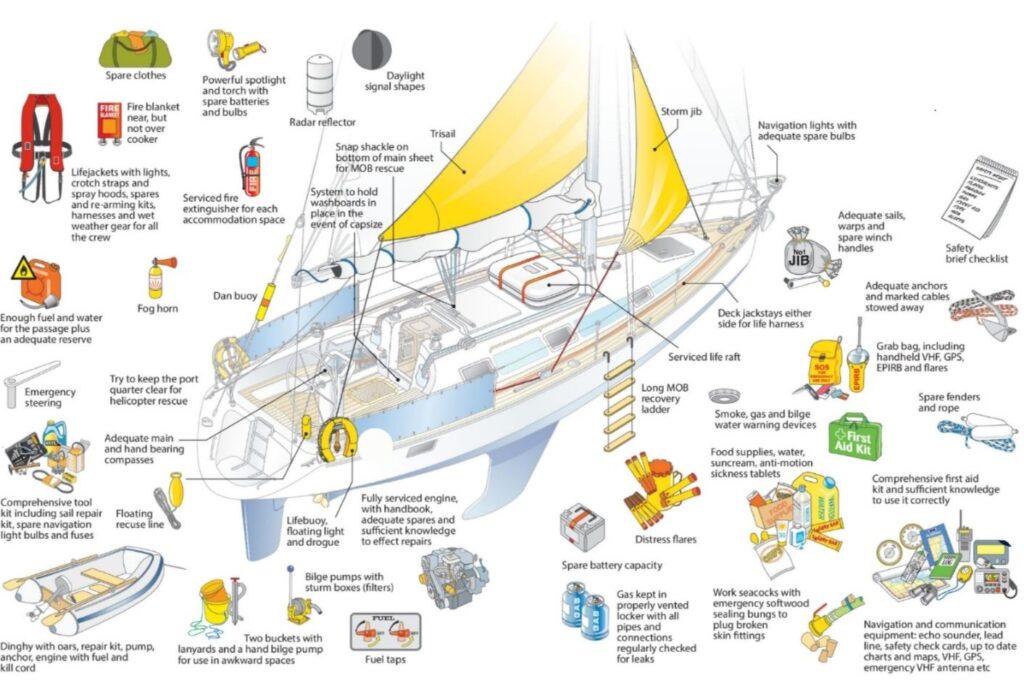
(RYA-aligned, minimum standard)
A Day Skipper is expected to give a full safety brief before departure, regardless of trip length, weather, or crew experience. The purpose is risk control, not reassurance.
1. Lifejackets & Personal Safety
Location of all lifejackets
Demonstrate correct fitting
Explain when lifejackets must be worn:
At night
In rough weather
On deck when sailing or manoeuvring
By children at all times (if applicable)
Show how to activate light, whistle, sprayhood if fitted
Explain jackstays and safety lines if carried
2. Safe Movement on Deck
One hand for the boat, one for yourself
Move only when necessary
No running
No standing in loops or bights of rope
Keep fingers clear of winches and blocks
Stay seated during manoeuvres unless instructed
3. Man Overboard Procedure
Crew must know exactly what to do immediately:
Shout “MAN OVERBOARD”
Point continuously at the casualty
Throw flotation if instructed
Do NOT jump in unless told by skipper
Explain briefly how recovery will be done (no detailed drill required)
4. Fire Safety
Location of fire extinguishers
Type of extinguishers carried
Location of fire blanket (if fitted)
Engine fire procedure:
Stop engine
Fuel off
Close engine air supply
Use extinguisher through fire port if fitted
Do not open engine compartment
5. Seacocks & Flooding Awareness
What a seacock is
Which ones are critical:
Engine cooling intake
Heads inlet/outlet
When to close seacocks:
Leaving the boat
If flooding occurs
Location of bilge pump(s) and how to operate them
6. Heads (Toilet) Use
Demonstrate correct operation
Explain what must NOT be put down the toilet
Explain how to avoid blockages
Advise crew to ask if unsure
7. Engine & Propeller Safety
Engine control location
Explain danger of propeller:
Never go near prop when engine running
Never enter water without skipper’s permission
Explain neutral, ahead, astern awareness during manoeuvres
8. Electrical & Gas Safety (if applicable)
Battery isolator switch location
Gas shut-off location (if gas fitted)
No naked flames below decks
Smell of gas = report immediately, do not operate switches
9. Emergency Equipment
Location of:
First aid kit
Lifebuoy / horseshoe / danbuoy
Torch
Explain who may access equipment
10. Communication
Location of VHF radio
Who is allowed to use it
Basic instruction:
In an emergency: inform the skipper immediately
No need to teach procedure unless appropriate to crew
11. General Conduct
Alcohol policy (normally none while underway)
Smoking policy
Seasickness advice:
Tell skipper early
Any specific boat rules